

已发布
2026年11月26日
分享
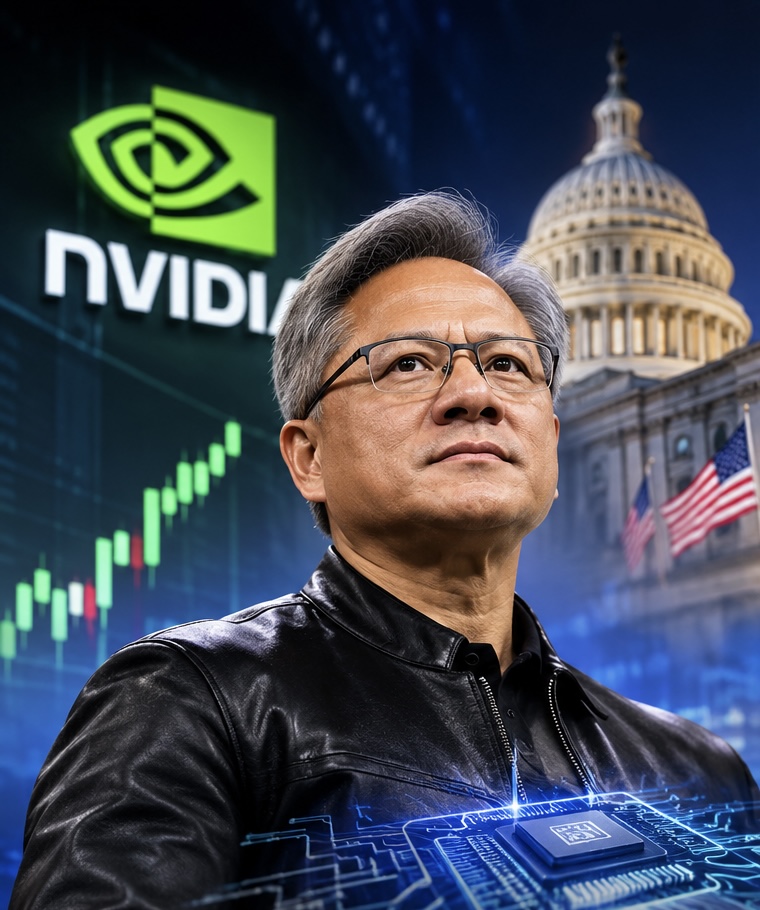
The artificial intelligence industrial force represented by Jensen Huang and NVIDIA stands at the intersection of technological competition, national strategy and capital markets.
Behind the Jensen Huang Leadership Turmoil—How Technological Power Is Reshaping the Global Innovation Order
Xie Yunlong
Founder, Executive Chairman, and Secretary-General of the World Innovation Congress (WIC)
In the age of artificial intelligence, the strategic value of technology companies is increasingly extending beyond traditional market boundaries. When a company’s technology platforms, industrial ecosystem, and core products become essential pillars of the global innovation system, its business decisions can have implications for national competitiveness, capital market expectations, and the international industrial landscape.
In November 2026, Jensen Huang, CEO of NVIDIA, experienced a dramatic reversal involving his resignation and reinstatement. From the company’s announcement on November 12 that he had resigned as president, chief executive officer, and board member, to the announcement on November 23 that he had been restored to all three positions, a leadership change within a single company quickly became a major focus of attention across the global technology industry and capital markets.
This was not merely a personnel change. U.S. President Donald Trump publicly stated that he had communicated directly with NVIDIA’s board of directors and claimed that he had persuaded the board to reinstate Huang. NVIDIA’s board, in its formal announcement, stated that it had received input from senior U.S. government officials during the decision-making process. Following the announcement of Huang’s reinstatement, NVIDIA’s share price rose sharply.
The episode also raised broader issues concerning corporate codes of conduct, board governance, and national security. With relevant investigations still ongoing, different parties have offered differing accounts of the reinstatement process.
The significance of this episode, therefore, lies not simply in Jensen Huang’s personal position, but in a deeper transformation it reveals: as technology companies become important carriers of strategic capabilities, how are the relationships among corporate governance, national strategy, and market mechanisms being reshaped?
Understanding this transformation may be more important than evaluating any single personnel decision.
I. How Technological Power Is Formed: From Technical Advantage to Systemic Industrial Influence
In the past, the core competitiveness of technology companies was primarily reflected in technological innovation, product development, market expansion, and business models. Companies built advantages through market competition, while governments supported innovation through investment in basic research, industrial policies, and institutional environments.
Artificial intelligence is changing this traditional relationship.
NVIDIA’s influence, for example, no longer derives solely from the performance advantages of its GPU chips. It is built on a broader foundation that includes chip architecture, software platforms, development tools, data center systems, and an extensive developer ecosystem. Hardware and software reinforce one another, while technologies and applications continue to adapt to each other, gradually forming an industrial ecosystem with relatively high switching costs.
This ecosystem has made NVIDIA a major provider of global AI infrastructure. Large cloud computing companies, AI developers, and users across numerous industries rely on its technologies and products to build computing capacity, develop models, and advance applications.
The influence generated by this ecosystem has consequently exceeded what traditional market share alone can fully explain.
When a company’s technology platform becomes deeply embedded in industrial operations, its product supply, technology roadmap, investment decisions, and organizational stability may affect the pace and cost structure of development across a much broader industrial landscape. What the company possesses is not merely a competitive advantage in individual products, but a form of systemic capability that can significantly influence the functioning of an industrial ecosystem.
This does not mean that NVIDIA is the only source of technology or that it is irreplaceable. In-house chip development, open-source software, diversified supply chains, and alternative technological approaches may gradually reshape existing dependencies. Nevertheless, at the current stage of AI industry development, NVIDIA’s technological advantages and ecosystem influence have placed it in a position of particular strategic significance.
Technological power is thus taking on a new form. It is no longer simply about possessing a leading technology, but about being able to influence the innovation capabilities and development choices of other actors through technology platforms and industrial ecosystems.
II. Why Governments Intervene: The Boundary Between Strategic Support and Corporate Governance
The Trump administration’s support for Huang’s reinstatement has a clear strategic context.
Artificial intelligence has become a major field in which the United States seeks to maintain technological leadership, promote economic growth, and strengthen national competitiveness. NVIDIA’s position in the global AI industry means that changes in its leadership can affect not only the company itself, but also broader expectations regarding the U.S. AI industry.
From a national strategic perspective, it is understandable that a government would seek to preserve the innovation capacity, industrial vitality, and global competitiveness of key technology companies. For technologies with significant national security implications, governments also have responsibilities to conduct risk assessments, compliance reviews, and policy coordination.
The deeper question, however, is not whether governments should engage with strategically vital tech companies, but how to bridge national strategic objectives and corporate governance through clear, stable, and predictable institutional arrangements.
A corporate board is responsible for governance and must consider the company’s long-term development, shareholders’ interests, management capabilities, compliance obligations, and risk control. Governments, by contrast, assess the strategic significance of key technologies and companies from the perspectives of national security, industrial policy, and the public interest.
The two may share common interests, but their respective responsibilities are not interchangeable.
National security assessments can provide important information and policy guidance for corporate decisions, but boards must still assume independent responsibility for their governance decisions. A company’s strategic value may justify government support for innovation, but it cannot exempt the company from compliance obligations or weaken governance standards.
The Huang reinstatement episode attracted attention precisely because public government involvement, board decision-making, and the return of a corporate leader converged directly in the same process.
As the strategic importance of technology companies continues to grow, governance boundaries cannot depend solely on ad hoc coordination or personal relationships. They require more transparent procedures, clearly defined responsibilities, and effective oversight.
Mature innovation governance does not mean simply expanding government intervention, nor does it mean placing strategically important technology companies entirely outside the scope of national strategy. Rather, it requires effective institutional coordination among national security, market mechanisms, and corporate governance.

III. How Capital Markets Respond: What Uncertainties Are Being Priced?
Following the announcement of Huang’s reinstatement, NVIDIA’s share price rose sharply, and the market response was swift and strong.
This reaction reflects the close connection between investors’ concerns about NVIDIA’s leadership stability and their expectations for the future of the AI industry.
From the perspective of traditional corporate valuation, a company’s value is primarily determined by its profitability, growth expectations, cash flow, competitive advantages, and risk profile. In the AI industry, however, the market value of technology companies is also significantly influenced by their strategic position, ecosystem influence, and critical role in the industrial value chain.
NVIDIA’s distinctive position lies in the fact that its technologies and ecosystem affect not only its own business, but also the pace, cost, and technological choices involved in building global AI infrastructure. Investors’ attention to Huang’s future therefore reflects a broader assessment of the company’s strategic continuity, organizational stability, and industrial leadership.
What the market is evaluating is not merely the personal capability of a chief executive, but also whether the company can maintain its pivotal position in the global AI industry.
Yet market reactions must be interpreted with caution.
The return of a leader may reduce short-term uncertainty, but it cannot automatically resolve long-term challenges such as the return on AI investment, the cost of data center construction, the sustainability of computing demand, intensifying technological competition, or corporate governance.
A sharp rise in the share price reflects the market’s short-term repricing of information and expectations. It does not constitute a final confirmation of a company’s long-term value. In the short term, markets may also amplify dependence on a key individual, potentially obscuring deeper issues involving organizational structure, succession planning, and governance quality.
Capital markets can rapidly price the strategic position and future expectations of technology companies, but they cannot replace the long-term test of value through industrial development.
IV. The Deepening Intersection of Technology and National Strategy: A Changing Global Innovation Order
The Huang episode is not an isolated phenomenon.
In recent years, advanced semiconductors, artificial intelligence, quantum technologies, biotechnology, and critical digital infrastructure have increasingly been incorporated into national competitiveness and economic security strategies. The operating environment for technology companies has consequently undergone profound changes.
On the one hand, companies need global markets, international talent, cross-border supply chains, and open innovation networks. On the other hand, national security concerns, export controls, technology reviews, and industrial policies are increasingly shaping the space in which they operate globally.
The global innovation system is evolving from a model driven primarily by market efficiency and international specialization toward a more complex landscape in which market efficiency, national security, and strategic competition interact.
However, technological competition does not necessarily mean the end of innovation cooperation.
The development of artificial intelligence continues to depend on basic research, talent exchange, industrial collaboration, and broad application. No country or company can realistically rely on a closed system to complete every stage of innovation independently. Excessive closure may increase research and application costs, reduce the efficiency of global resource allocation, and weaken the diversity of innovation systems.
At the same time, ignoring critical technology dependencies, supply chain vulnerabilities, and security risks would also make it difficult to build sustainable innovation capabilities.
The central challenge of global innovation governance is therefore not to choose between openness and closure. It is to identify and manage risks within a reality of interdependence while preserving stable space for cooperation.
This requires governments to avoid an unlimited expansion of the concept of security while protecting legitimate national interests. It requires companies to assume appropriate compliance obligations and international responsibilities while pursuing global markets and technological advantages. It also requires the international community to explore clearer and more predictable rules and mechanisms for coordination.
The stability of the future global innovation order will depend not only on the outcomes of technological competition, but also on whether different parties can establish a basic understanding of its boundaries.
V. From Technological Leadership to Governance Capability: The Deeper Dimension of Future Competition
The Huang leadership episode may reveal an important shift in the meaning of national competitiveness in the age of artificial intelligence.
Technological breakthroughs, research and development investment, talent reserves, and industrial scale remain fundamental to technological competition. Yet as AI’s impact on society, the economy, and national security continues to expand, the importance of innovation governance is also increasing.
Technological capability determines what a country can achieve. Industrial capability determines the extent to which technology can be transformed into real productive capacity. Governance capability, in turn, influences how technology is applied, how risks are controlled, how responsibilities are assigned, and whether innovation can continue to create social value.
This means that future technological competition will be not only a competition in technology and capital, but also one in institutions and governance capability.
A sustainably competitive innovation system must be able to support long-term basic research and technological breakthroughs, establish effective mechanisms for market competition and industrial commercialization, maintain reasonable boundaries between national security and corporate autonomy, and preserve an open, stable, and predictable environment for global cooperation.
Technology companies should not be viewed merely as instruments of national competition. They are both organizers of innovation and participants in innovation governance. They need stable policy and security environments provided by governments, while responding to their expanding public influence through sound corporate governance, compliance systems, and social responsibility.
Government support for technological innovation should respect the principles of corporate governance and market mechanisms. Companies with significant strategic importance should assume higher standards of governance responsibility. The global innovation system, meanwhile, must preserve space for cooperation amid competition and avoid unnecessary institutional barriers while addressing legitimate security concerns.
These issues concern not only the future of a single company, but also whether artificial intelligence can truly become a powerful force for the common development of humanity.

Conclusion: The Growth of Technological Power Must Be Matched by Governance Capability
Jensen Huang’s resignation and reinstatement within 11 days presented a highly dramatic episode in technology company governance. Yet when the perspective shifts from an individual’s position to the global innovation system, a deeper transformation becomes visible: the strategic position of technology companies, the ways in which governments engage with them, and the logic through which capital markets evaluate them are all undergoing significant change.
Artificial intelligence is redefining the value of technology companies—and, in turn, the meaning of national competitiveness.
As technology companies become important carriers of national strategic capabilities, their influence inevitably extends beyond traditional market boundaries. As that influence grows, corporate governance, national policy, and global innovation cooperation must develop more mature mechanisms for coordination.
The innovation systems that remain competitive over the long term will require not only leading technologies, abundant capital, and strong industrial foundations, but also governance capabilities commensurate with their technological influence.
Technological leadership determines the height of innovation. Industrial capability determines its breadth. Governance capability determines how long innovation can be sustained and how it will shape the world.
This may be one of the most important lessons emerging from global innovation competition in the age of artificial intelligence.

Pictured: Author Xie Yunlong.
文章来源:世界创新大会秘书处,版权属于原作者,转载请注明文章作者及来源。


点击右上角分享按钮