

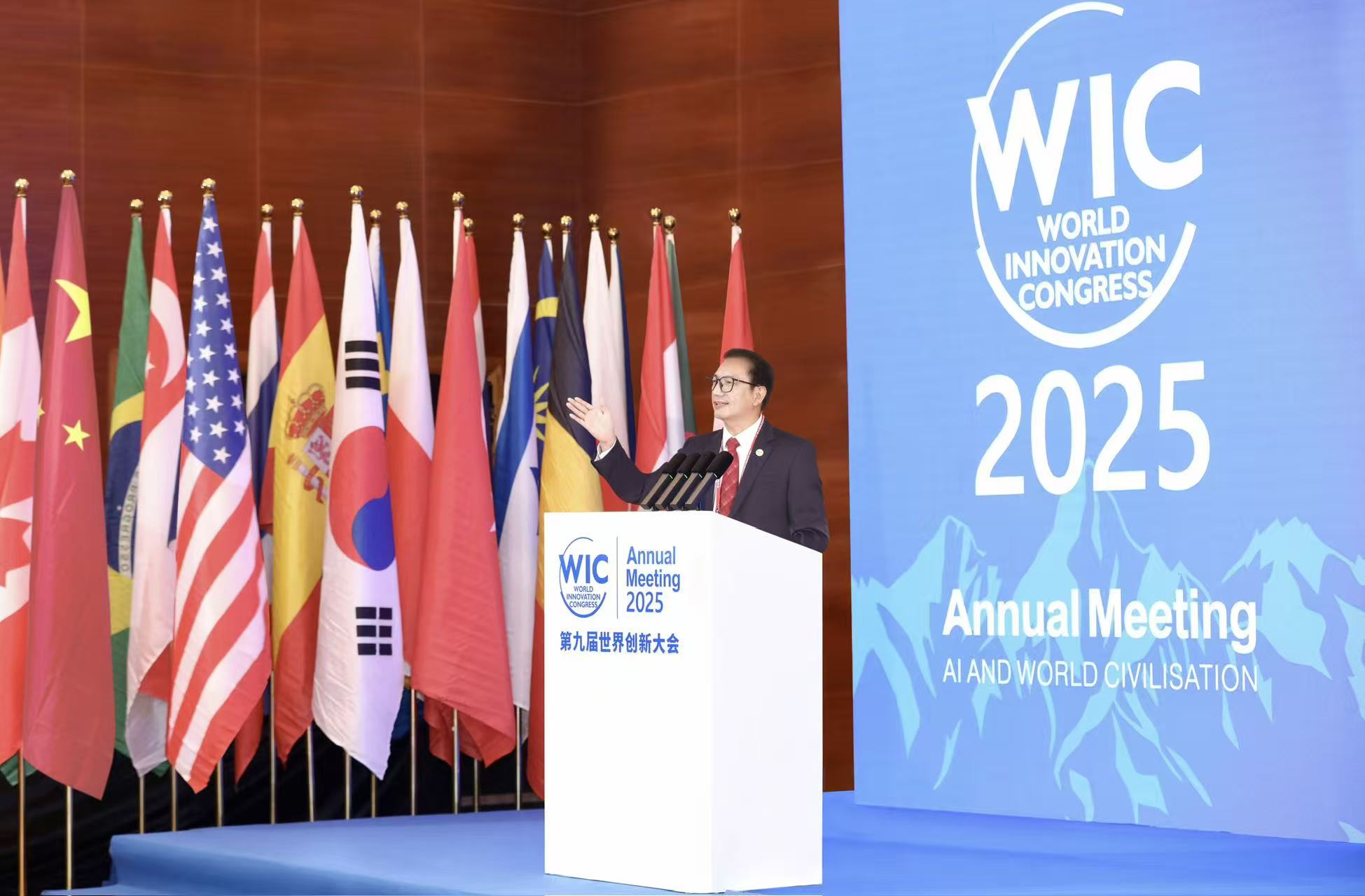
谢云龙简介
谢云龙(YunLoong Xie),本名谢建超,管理学硕士,哲学博士研究生。世界创新大会(WorldInnovation Congress, WIC)创始人兼秘书长,全球创新战略研究学者。系中国创新大会(ChinaInnovation Congress, CIC)发起人,世界创新大奖发起人,全球创新共同体倡议发起人。曾在国务院发展研究中心系统任职多年,长期从事全球创新技术、产业观察和创新政策、战略与治理研究。
谢云龙始终秉持“服务国家创新发展、促进国际创新合作交流、构建全球创新共同体,让创新造福人类”的初心和使命,凭借强烈的社会责任感与开拓精神,历经十余年深耕,成功搭建起立足中国、链接世界、具有全球影响力的世界创新大会(WIC)国际平台。
在他的带领下,世界创新大会已成功举办九届全球年会及数十场国际会议。大会汇聚300余位全球杰出领袖发表远见卓识的主题演讲,吸引100多个国家和地区的12000余名参会者,涵盖顶尖科学家、政府高层代表、国际组织负责人、工商界领袖及优秀青年学者;推动数十项重大科技创新成果从会议走向产业应用,仅2023年至2025年,促成跨国产业投资与经贸合作签约金额突破400亿元,以系列务实成效推动“全球创新共同体”从理念落地为合作实景,充分展现了平台链接全球创新资源、赋能国家创新发展的核心实践价值。在中国政府的大力支持与全球合作伙伴的持续参与下,WIC已成为全球创新领域极具广泛影响力的国际平台,既为国家创新发展战略提供了有力支撑,也为国际创新合作交流及全球创新共同体构建作出了重要贡献。

谢云龙创办世界创新大会(WIC)的战略过程
WIC的诞生并非偶然,而是谢云龙基于长期实践调研与战略思考的必然成果,其战略脉络可追溯至21世纪初广东转型关键期,始终与国家创新发展战略同频共振:
2010年,广东刚从国际金融危机的冲击中企稳回升,彼时“腾笼换鸟、转型升级”战略已落地两年有余,全省正处于深化产业结构调整的初级阶段。传统外向型劳动密集型产业的发展瓶颈集中显现,旧有发展模式难以为继,以创新驱动破局、推动产业优化升级的需求愈发迫切。作为国家核心智库机构中央某媒体派驻广东省的负责人,谢云龙凭借资深媒体人对时代脉动的敏锐把握与一线调研的天然优势,深度聚焦传统企业转型升级路径与创新驱动可持续发展课题,耗时一年多深入珠三角地区开展实地走访,近距离洞察区域产业转型的痛点与创新突破的关键机遇。
2011年上半年,在广东省委党校中青年领导干部培训班学习期间,谢云龙结合调研所见所感,撰写《依托广东开放优势 构建国际创新合作平台 服务国家创新发展战略》一文,首次系统提出搭建国际创新交流平台的战略构想,为后续实践奠定了坚实的思想基础。
2012年12月7日-11日,习近平总书记上任后首站赴广东视察,明确指出:“国际经济竞争甚至综合国力竞争,说到底就是创新能力的竞争。谁能在创新上下先手棋,谁就能掌握主动”。同时提出,要大力实施创新驱动发展战略,加快完善创新机制,全方位推进科技创新、企业创新、产品创新、市场创新、品牌创新,推动科技与经济紧密结合。总书记的重要讲话,与谢云龙深耕珠三角调研形成的认知高度契合,更坚定了他以创新平台赋能区域转型、服务国家发展的实践方向。
2012-2013年期间,谢云龙持续深化调研,走遍珠三角多地,与重点国有企业、民营企业负责人及地方市委书记、市长等深入交流,广泛汇集政企学界对创新发展的诉求与建议。他一边将调研成果转化为深度报道公开发表,向社会传递创新发展共识;一边撰写专题调研报告呈送中央及广东省委省政府,为顶层设计提供一线实践参考,形成“调研-传播-献策”的闭环实践。2013年,凝聚两年调研心血的近40万字著作《领航—广东改革观察》正式付梓,该书得到中央及广东省有关部门领导的高度重视与肯定批示,时任国务院发展研究中心副主任韩俊亲自为该书作序,对书中聚焦的企业科技创新路径与地方经济改革创新议题给予高度评价,为战略构想提供了坚实的理论与实践支撑。
2014年,习近平总书记在两院院士大会上发表重要讲话,强调“科技创新是提高社会生产力和综合国力的战略支撑,必须摆在国家发展全局的核心位置”,号召“广大科技工作者要树立强烈的创新自信,敢于质疑现有理论,勇于开拓新的方向,不断在攻坚克难中追求卓越,奋力取得基础性、战略性、原创性的重大成果”。这一重要论述为我国创新发展指明了实践路径,也让谢云龙更加清晰地锚定了平台搭建的核心方向——聚焦硬核科技、链接全球资源、促进成果转化。
2015年,以习近平同志为核心的党中央提出“创新、协调、绿色、开放、共享”五大发展理念,将创新置于发展全局的核心首位,明确要求“必须把创新摆在国家发展全局的核心位置,不断推进理论创新、制度创新、科技创新、文化创新等各方面创新,让创新贯穿党和国家一切工作,让创新在全社会蔚然成风”。这一重大战略部署,与谢云龙多年深耕创新领域形成的认知体系深度契合,为其将战略构想转化为具体实践提供了根本遵循,也进一步坚定了他搭建专业创新平台、精准服务国家战略需求的决心。
也正是在这一年,谢云龙立足多年调研积累与国家创新战略部署,正式向中央及广东省委提交创办“中国创新大会,服务国家创新发展战略”的专项建议,并提出先办中国创新大会,后办世界创新大会的构想,系统阐述平台创办的时代意义、核心定位与实施路径。
2016年1月,习近平总书记在省部级主要领导干部学习贯彻党的十八届五中全会精神专题研讨班开班式上,再次深刻指出“抓住了创新,就抓住了牵动经济社会发展全局的‘牛鼻子’”这一重要论述。这一论述进一步凸显了创新在国家发展全局中的核心引领作用,为各地各领域落实创新驱动发展战略提供了更加明确的行动指引。为深入贯彻习近平总书记关于创新发展的重要论述和重要指示精神,精准对接国家创新发展战略,谢云龙的建议得到中央相关部委的高度重视与肯定性批示。在政策指引与多方支持下,他以开创性战略思维发起并推动创办“中国创新大会(CIC)”,将多年积累的调研成果与战略构想正式转化为具体实践。
2017年6月,首届中国创新大会在广州成功举办。大会获得国务院发展研究中心、科学技术部、国家发展和改革委员会、工业和信息化部及广东省委、省政府等单位的指导与大力支持,时任中共中央政治局委员、广东省委书记胡春华宣布大会开幕,10余位部省领导致辞,30余位顶尖科学家与知名企业家作主旨演讲,吸引100多个国家和地区的1500余位嘉宾代表参会,引发国际社会广泛关注。
2018年,在CIC成功运营的基础上,为更主动地链接全球创新资源、响应全球创新合作的时代诉求,谢云龙以前瞻性国际视野创办“创新全球论坛(IGF)”,搭建起高水平国际创新对话平台,为大会体系注入国际化基因,积累了丰富的全球合作资源与跨区域协同经验。
2019年,基于前期扎实的实践成果与全球创新格局的发展变化,谢云龙战略性整合“中国创新大会”与“创新全球论坛”两大平台资源,将其升级为“世界创新大会(WIC)”,推动平台实现从国家级到国际创新平台的跨越式发展,正式开启致力于全球创新推动与国际合作交流的新篇章。大会以“构建全球创新共同体、让创新造福人类”为使命,打造立足中国、链接世界、具有全球影响力的国际新型组织,成为政界、科学界、工商界及国际组织深度交流合作的重要桥梁,持续为全球创新生态建设注入中国动能。
2019-2026,世界创新大会已成功举办九届全球年会及数十场国际会议。2026年,世界创新大会迎来了十周年重要里程碑。
Dr. YunLoong Xie, Secretary-General and Founder of the World Innovation Congress (WIC)
YunLoongXie, whose real name is Xie Jianchao, holds a Master's degree in Management and is a doctoral candidate in Philosophy. Founder and Secretary-General of the World Innovation Congress (WIC), and a scholar specializing in global innovation strategy research. He is also the initiator of the China Innovation Congress (CIC), the World Innovation Awards, and the Global Innovation Community Initiative. Having served for many years within the system of the Development Research Center of the State Council, he has long been engaged in research on global innovation technologies, industrial observation, and innovation policies, strategies, and governance.
Guided by his founding mission—“serving national innovation development, fostering international innovation cooperation and exchange, building a global innovation community, and enabling innovation to benefit humanity”—YunlongXie has, with strong social responsibility and pioneering spirit, dedicated over a decade to establishing the World Innovation Congress (WIC) as an international platform rooted in China, connected to the world, and possessing global influence.
Under his leadership, WIC has successfully hosted nine global annual conferences and dozens of international meetings. The conferences have gathered over 300 global leaders to deliver visionary keynote speeches, attracting more than 12,000 participants from over 100 countries and regions. These attendees include top scientists, high-level government representatives, heads of international organizations, business leaders, and outstanding young scholars. It has propelled dozens of major scientific and technological innovations from conference presentations to industrial applications. From 2023 to 2025 alone, it facilitated cross-border industrial investment and economic cooperation agreements exceeding 40 billion yuan. Through a series of tangible achievements, it has transformed the concept of a “Global Innovation Community” into concrete collaborative realities, fully demonstrating the platform's core practical value in connecting global innovation resources and empowering national innovation development. With strong support from the Chinese government and sustained participation from global partners, WIC has evolved into an internationally influential platform in the global innovation sphere. It not only provides robust support for national innovation development strategies but also makes significant contributions to international innovation cooperation and the construction of the Global Innovation Community.
Strategic Development of the World Innovation Congress (WIC)
The emergence of WIC was no accident, but rather the inevitable outcome of Xie Yunlong's long-term practical research and strategic thinking. Its strategic lineage traces back to Guangdong's critical transformation period in the early 21st century, consistently aligning with the nation's innovation and development strategy:
In 2010, Guangdong had just stabilized and rebounded from the impact of the global financial crisis. At that time, the “replacing old industries with new ones and upgrading industrial structures” strategy had been implemented for over two years, and the province was in the early stages of deepening industrial restructuring. Development bottlenecks in traditional export-oriented, labor-intensive industries became increasingly apparent, and the old development model was unsustainable. The need to break through the impasse through innovation-driven development and promote industrial optimization and upgrading became ever more urgent. As the head of a national core think tank media outlet stationed in Guangdong Province, Xie Yunlong leveraged his seasoned media professional's keen grasp of the era's pulse and the inherent advantages of frontline research. He deeply focused on the pathways for traditional enterprises to transform and upgrade, as well as the topic of innovation-driven sustainable development. Over the course of more than a year, he conducted in-depth field visits throughout the Pearl River Delta region, gaining close-up insights into the pain points of regional industrial transformation and the key opportunities for innovation breakthroughs.
In the first half of 2011, while attending a training program for middle-aged and young leading cadres at the Guangdong Provincial Party School, Xie Yunlong synthesized his research findings into the paper “Leveraging Guangdong's Open Advantages to Build an International Innovation Cooperation Platform Serving the National Innovation Development Strategy.” This work systematically proposed the strategic vision of establishing an international innovation exchange platform for the first time, laying a solid ideological foundation for subsequent implementation.
From December 7 to 11, 2012, during his first inspection tour of Guangdong after assuming office, General Secretary Xi Jinping clearly stated: "International economic competition, and even competition in comprehensive national strength, ultimately boils down to competition in innovation capabilities. Whoever takes the initiative in innovation will seize the upper hand." He also called for vigorously implementing an innovation-driven development strategy, accelerating the improvement of innovation mechanisms, and comprehensively advancing scientific and technological innovation, enterprise innovation, product innovation, market innovation, and brand innovation to promote the close integration of science and technology with the economy. The General Secretary's important speech resonated deeply with Xie Yunlong's insights gained from his extensive research in the Pearl River Delta, further solidifying his commitment to empowering regional transformation and serving national development through innovation platforms.
During 2012-2013, Xie Yunlong deepened his research by traversing multiple regions in the Pearl River Delta. He engaged in in-depth discussions with leaders of key state-owned and private enterprises, as well as local Party secretaries and mayors, extensively gathering demands and suggestions for innovation-driven development from government, business, and academic circles. He simultaneously transformed his research findings into in-depth reports for public release, fostering societal consensus on innovation-driven development, while also drafting thematic research reports submitted to the central government and the Guangdong Provincial Party Committee and Provincial Government. These reports provided frontline practical references for top-level design, forming a closed-loop practice of “research-dissemination-policy recommendations.” In 2013, his nearly 400,000-word magnum opus, “Navigating Change: Observations on Guangdong's Reforms,” culminating two years of research, was published. The book garnered significant attention and positive endorsements from leaders at the central and Guangdong provincial levels. Han Jun, then Vice President of the Development Research Center of the State Council, personally wrote the foreword, highly commending the book's focus on corporate technological innovation pathways and local economic reform initiatives, thereby providing robust theoretical and practical support for strategic concepts.
In 2014, General Secretary Xi Jinping delivered a significant speech at the Joint Conference of Academicians of the Chinese Academy of Sciences and the Chinese Academy of Engineering. He emphasized that “scientific and technological innovation is a strategic pillar for enhancing social productivity and national comprehensive strength, and must be placed at the core of national development.” He called upon “scientists and technologists to cultivate strong confidence in innovation, dare to question existing theories, boldly pioneer new directions, relentlessly pursue excellence in overcoming challenges, and strive to achieve fundamental, strategic, and original breakthroughs.” This important exposition charted a practical course for China's innovation-driven development and enabled Xie Yunlong to more clearly anchor the core direction of platform building—focusing on cutting-edge technologies, connecting global resources, and promoting the transformation of scientific achievements.
In 2015, the Party Central Committee with Comrade Xi Jinping at its core proposed the five development concepts of “innovation, coordination, green development, openness, and sharing,” placing innovation at the forefront of the overall development strategy. It explicitly required that “innovation must be placed at the core of the nation's development strategy, continuously advancing innovation in theory, systems, science and technology, culture, and other areas, ensuring innovation permeates all work of the Party and the state, and fostering an atmosphere of innovation throughout society.” This major strategic deployment deeply resonated with Xie Yunlong's cognitive framework, forged through years of dedicated work in the innovation field. It provided fundamental guidance for translating strategic concepts into concrete actions and further solidified his resolve to build a professional innovation platform that precisely serves national strategic needs.
It was in this very year that Xie Yunlong, drawing upon years of research and the national innovation strategy, formally submitted a special proposal to the Central Committee and the Guangdong Provincial Party Committee to establish the “China Innovation Conference to serve the national innovation development strategy.” He proposed the concept of first launching the China Innovation Conference, followed by the World Innovation Conference, systematically elaborating on the platform's contemporary significance, core positioning, and implementation pathways.
In January 2016, at the opening ceremony of a special seminar for provincial and ministerial-level leading cadres to study and implement the spirit of the Fifth Plenary Session of the 18th CPC Central Committee, General Secretary Xi Jinping profoundly reiterated the important statement: “Grasping innovation means grasping the ‘bull by the horns’ that drives the overall development of the economy and society.” This statement further highlighted the core leading role of innovation in the overall national development and provided clearer action guidance for all regions and sectors to implement the innovation-driven development strategy. To thoroughly implement General Secretary Xi Jinping's important directives on innovation-driven development and precisely align with the national innovation strategy, Xie Yunlong's proposal received high attention and affirmative approval from relevant central ministries and commissions. Guided by policy and supported by multiple stakeholders, he initiated and spearheaded the establishment of the China Innovation Conference (CIC) through pioneering strategic thinking, formally transforming years of research findings and strategic concepts into concrete practice.
In June 2017, the inaugural China Innovation Conference was successfully held in Guangzhou. The conference received guidance and strong support from the Development Research Center of the State Council, the Ministry of Science and Technology, the National Development and Reform Commission, the Ministry of Industry and Information Technology, as well as the Guangdong Provincial Party Committee and Provincial Government. Hu Chunhua, then Member of the Political Bureau of the CPC Central Committee and Secretary of the Guangdong Provincial Party Committee, declared the conference open. Over 10 leaders from ministries and provincial governments delivered addresses, while more than 30 top scientists and renowned entrepreneurs gave keynote speeches. The event attracted over 1,500 delegates from more than 100 countries and regions, drawing widespread international attention.
In 2018, building upon the successful operation of CIC and to proactively connect global innovation resources while responding to the era's demand for international innovation cooperation, Xie Yunlong founded the Innovation Global Forum (IGF) with a forward-looking international vision. This established a high-level international innovation dialogue platform, infusing the conference system with international elements and accumulating rich global cooperation resources and cross-regional collaboration experience.
In 2019, building upon solid practical achievements and shifts in the global innovation landscape, Xie Yunlong strategically integrated the resources of two major platforms—the China Innovation Conference and the Innovation Global Forum—to elevate them into the World Innovation Conference (WIC). This initiative propelled the platform from a national-level to an international innovation platform, marking a leap forward in its development and formally launching a new chapter dedicated to advancing global innovation and fostering international cooperation and exchange. Guided by the mission to “Build a Global Innovation Community and Harness Innovation for Humanity,” the conference has evolved into a globally influential international organization rooted in China yet connected to the world. It serves as a vital bridge for deepened exchanges and collaboration among governments, scientific communities, business sectors, and international organizations, continuously injecting Chinese momentum into the development of the global innovation ecosystem.
From 2019 to 2026, the World Innovation Congress has successfully hosted nine global annual conferences and dozens of international meetings. In 2026, the World Innovation Congress reached its significant milestone of its tenth anniversary.